
Earlier in the day we were underway and heading into Holkham Bay with the intention of going for a hike on Wood Spit. Off in the distance, we spotted a couple of killer whales. They were moving fast and entering the bay. We tried to follow, but lost them as they swam quickly and entered the adjacent Endicott Arm. Jeffrey and I talked about the likelihood of seeing them again after our walk at Wood Spit.
So we anchored the David B, lowered Skiffy-a-saurus into the water, and off our group went for our walk. We poked around in tide pools and looked for bear tracks in the mud and sand. We entered the forest and felt the squish of thick moss on bear maintained trails. We identified plants and talked about ecology, and spotted a black bear. At one point Jeffrey radioed me to say that Wilderness Ranger Chrissy was nearby and that we could meet up with her on the beach. After a little planning, we set out across the spit covered in shoulder-high ferns to meet Chrissy and talk about the wilderness area that was all around us.
While we were chit-chatting, we heard the distinct blow of a surfacing killer whale. It stopped all conversations. We watched mesmerized as two mammal-eating killer whales searched the bay for food. They came within 200 yards of the beach, and we were transfixed as they skirted shallows and searched icebergs. It was a beautiful encounter and we watched them swim round the end of the point. We thought it was the last we’d see of them…we were wrong.
We said our goodbyes to Ranger Chrissy and radioed for Jeffrey to come pick us up. On our way back to the David B, the whales surfaced next to us. For the next hour the whales showed us how to hunt seals. We sat in the skiff with the motor off. The whales swam in circles at times, or in straight lines. They alternated which one was at the surface. We watched them make a kill. Their speed and grace was amazing. It was pure nature and we got to watch. It was a chance encounter and another chance to discover more about a world we seldom see.


 Some days are simply perfect. The weather’s warm. The skies are blue. The water flat calm, and the line between sea and sky is almost indistinguishable. We had a day like that in August. It was the kind of day that happens every-so-often in the temperate rain-forest climate of southeast Alaska. It was the kind of day where all the conditions were just right for watching humpback whales. Not only could we stop to watch, but we were able to turn off the engine and drift silently. Without background noise from the boat, we were able to experience something different. All around us, and spread out over several miles were humpback whales in groups of two or three, and alone. All foraging. When they would surface, their breath would make an explosive “swooshing” sound. Atomized water particles hung still in the air marking the spot where they had come up. It was hard to know where to look. The sounds of whales surrounded the boat. They would sometimes surface near to the David B. Other times they’d be distant. We just drifted upon the open water; watching, listening, observing.
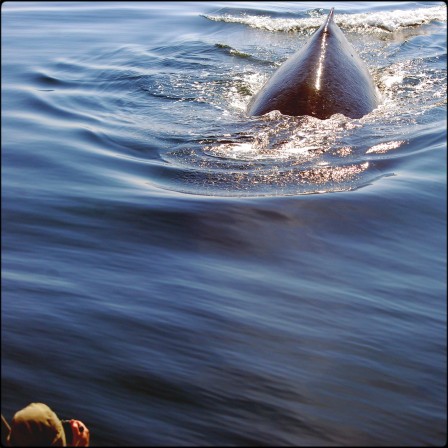 long pectoral fins faintly glowing against the deep dark water. Over the amplifier, a couple barking sounds and some bubbles could be heard. Then a few seconds later, a whale surfaced just off our starboard side. It lifted it’s fluke high and dove under the boat. Farther aft, the second whale surfaced and dove as well. There was a moment of joy, then wonder. I wondered why they chose that path? Where were they going? What did the sounds mean? How long would they remain under water? Where would they surface next?

 I always feel like there’s sort of a Jack-in-the-box element to watching