That time we anchored in Tracy Arm…

David B anchored at Tracy Arm Mud Flats

It was maybe the coolest thing we did all summer, and it wasn’t planned at all. I didn’t really mean to be there at that time of day anyway.

What started it all was a “boring” glacier in another fjord. We normally visit a glacier on our Juneau and Petersburg trips, and stay around for an hour or so to watch it calve, but this time — no luck.  We drifted around, and drifted around and nothing. The glacier was just sitting there, doing absolutely nothing. Maybe a couple little snowballs, but not like our normal shows. And it was really windy, so we kept having to maneuver to get back into position. There were lots of big icebergs that we pushed up against, and lots of brash ice and the whole thing was really annoying since nothing was going on with the glacier.

So I made a pronouncement “this glacier is boring! I’ll take you to see better one tomorrow.” Seemed like a good idea at the time.

The next morning we got underway at a nice civilized hour. The logbook says: “0935 — Underway“ Then everything seemed to slow us down. The tide was against us, we stopped for whales, we didn’t even make it out of Endicott Arm until well after lunch.

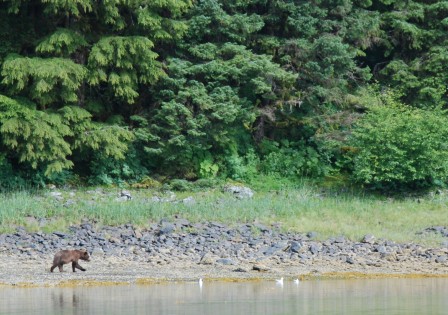
Black bear looking at kayakers un Tracy Arm
Black bear in Tracy Arm

And so, late in the afternoon we were headed up Tracy Arm and we weren’t going to make it. Turning around meant covering this same stretch of water two more times and if we kept on to the glacier, it was going to be dark on our way out. Not good when you’re trying to avoid icebergs.

So I did what anyone would do in that situation. I anchored right in the fjord. We’d been told about a spot where a river flows out into the fjord and pushes the icebergs away, but it didn’t seem that good, so we went back a few miles and dropped the hook on a shallow ledge where another stream flows out. We’d scooped out this spot a few weeks earlier, tested the depths and looked at how the stream flow pushed the ice away.

Seal eating a fish in Tracy Arm
Seal with fish

It was amazingly beautiful. Everyone got in kayaks and paddled around the little bergy bits that were nearby and watched a black bear at the water’s edge. Then we observed a seal eating salmon, and there was even a place to nose the kayaks into a little waterfall flowing into the fjord. Over dinner we spotted the bear again on the rocks high above us.

As darkness fell, Christine, Cass and I set an all night anchor watch, which was mostly an all night berg watch. We plotted the big ones with the radar, we scanned for small ones by searchlight. It was really eerie watching the huge bergs go by all night at a quarter knot or so, but it was too shallow for them to get close to us.  

When you go through a night like this, it seems almost bittersweet when it starts to get light. It was so serene and peaceful as the bergs marched slowly past us in the dark, first one way, then the other as the tide turned. There was a kind of magic to it. We were the only ones there quietly watching what the natural world had been doing for thousands of years

Sawyer glacier calving

The spell continued as it got light, and we got underway to be the first ones to the glacier. The sun shone brilliantly, and this time, the glacier performed.


-Captain Jeffrey

Cycles of the seasons

Whatcom Creek in Bellingham has a run of chum salmon
Whatcom creek runs through downtown Bellingham and is a popular place for sports fishermen looking to catch chum salmon.

Whenever I see salmon in our local streams or in far-away wild places, it reminds me of the endless cycles of the seasons that often seem to go unnoticed. It’s changing from fall to winter bringing big winds and rain. Leaves from the maple trees have all blown down, and the trails are muddy from the fallen leaves trampled into the soil. When the rain and the wind come to my home, I know that soon the chum salmon will too. And along with them, bald eagles and people will appear along the banks of our urban streams. All these things have come to symbolize to me that another cycle for the David B has ended.

Fall and winter are a busy time for us. Each year in October our trips are finished and it seems like spring is impossibly far away. I drive around town picking up parts for the boat, the mail at the post office, and doing other off-seasons tasks. I often go past Whatcom creek, a small salmon-bearing creek that empties into Bellingham Bay. The in-town anglers line up, elbow to elbow along a retaining wall for their chance to catch a fish.

The other day when I saw the crowd of fishermen it reminded me of a day few months earlier in mid-July when I was kayaking with some of our guests in Alaska — Cannery Cove at Admiralty Island to be specific. It’s one of the most scenic anchorages we visit — almost unbelievable in it’s beauty. From our anchorage, the 3800-foot high Bear Pass Mountain rises right from the edge of the cove. Between the water’s edge and the top of the peak an ancient forest covers the side of the mountain. The boughs of those old-old trees seem to cling to the slowly rising wisps of clouds. Ravens fill this basin-like cove with their throaty “kwork-kwork,” calls while eagles whistle from their high perches atop of impossibly tall trees. Multiple waterfalls are visible as they tumble down Bear Pass Mountain forming cold and snow-fed salmon streams. Here the chum salmon run earlier than those in Washington state.

Brown bear viewing in Cannery Cove on an 8-day Alaska cruise on the David B
A brown bear walks the beach in Cannery Cove where chum salmon come home to spawn in creeks that feed into the cove.

On that day in July we kayaked to a spot where I’d seen a brown bear the week earlier. I figured I might as well check it out again, and sure enough, almost as if on cue, a bear ambled out onto the beach. It was, like the scenery in Cannery Cove, almost unbelievable. My guests followed and we watched the bear eat grass, dig a little around the beach and walk along the water’s edge. As I held my kayak in place, dipping my paddle into the water and pulling back slightly, I focused my eyes into the shallows below my boat. The water was clear and I could see a deeper dark-bluish-green channel that lead through the tidally-submerged mudflats at the head of the cove. Something caught my eye. It was a school of chum salmon swimming purposefully through the deep channel. These fish were nearing the end of their life-cycle. Their bodies already showed the changes that salmon go through on their way to spawn in freshwater. No longer were they the sleek and silver salmon of the Pacific ocean, they were now greenish with distinctive purple tiger-stripes. If I’d been able to scoop one of them out of the water, I’d have seen that their mouths were developing a hooked snout and canine-like teeth. These changes were in preparation for their final stage in life — migration up their natal stream for their chance to spawn and to end one cycle while beginning another.

Chum salmon in Whatcom Creek
Chum salmon in the fast waters of Whatcom creek in Bellingham.

Our cyclical lifestyle is defined by our sailing season and our off-season. We’ve finished with our wilderness adventures on the David B for the year, and we’ve prepared it for winter. We’ve finalized our project list, and put a winter cover over the boat. Is it the beginning of a new cycle? Or the end of the old? It’s hard to know and it doesn’t really matter where the line is. What does matter is that during this part of the cycle we get to reconnect with past passengers who are planning to return to the David B, and connect with new people who will travel with us for the first time. In a few months the David B will emerge with fresh paint, new varnish, and upgraded systems. Soon after, we will set off for new adventures. And a new cycle.